

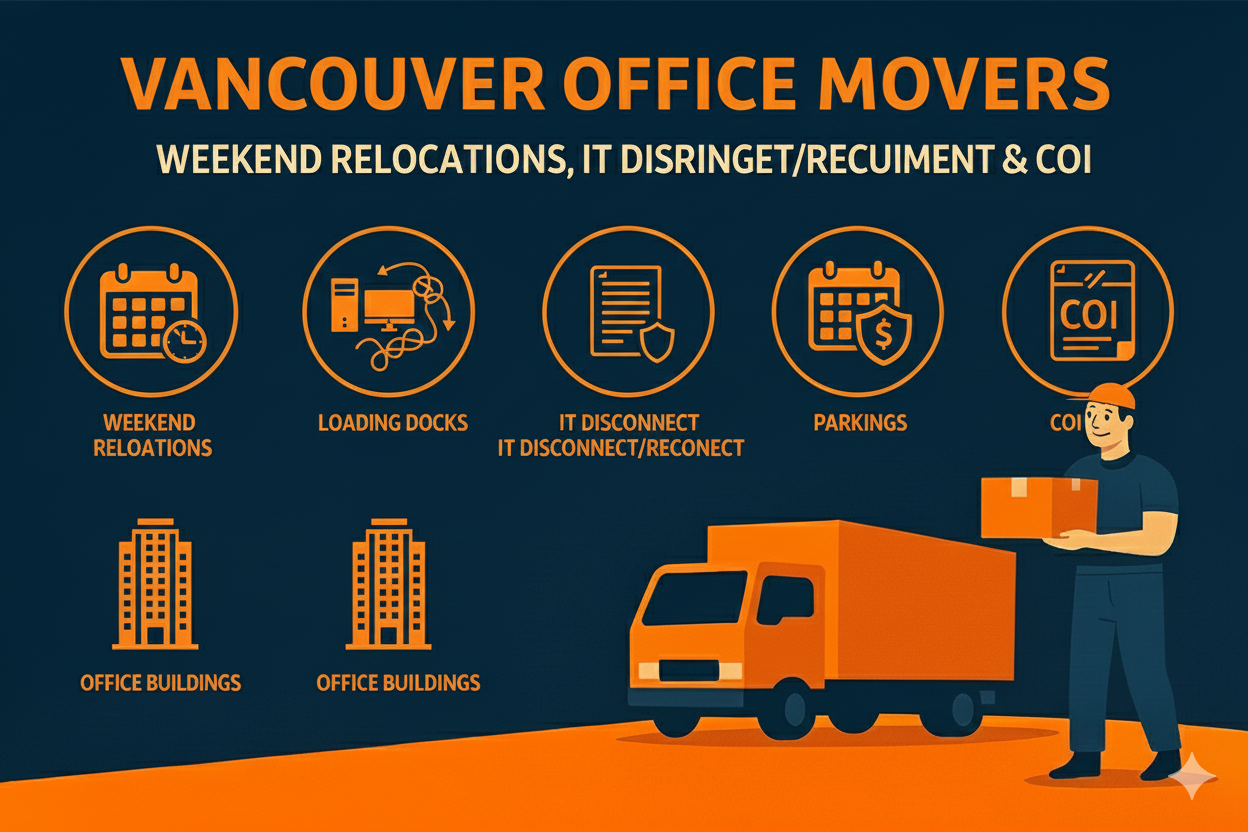
Relocating an office in Vancouver demands precision, coordination, and an operational strategy that protects your team’s productivity while ensuring your assets remain safe, insured, and professionally handled. Between freight elevator bookings, commercial building bylaws, strict Certificate of Insurance (COI) requirements, and the critical timing needed for IT disconnect and reconnect services, Vancouver office relocations have become significantly more complex than traditional residential moves.
This detailed guide provides a comprehensive, business-oriented breakdown of what Vancouver companies must consider—especially organizations operating in Downtown Vancouver, Yaletown, Coal Harbour, Mount Pleasant, Gastown, Fairview, and surrounding commercial districts. Whether moving a corporate office, startup headquarters, clinic, retail space, or warehouse operations, this article outlines the process to ensure a seamless transition with minimal downtime.
Understanding the Complexity of Office Moves in Vancouver
Office relocations differ drastically from residential moves due to three factors: timing, infrastructure, and commercial compliance requirements. Vancouver’s commercial buildings often require pre-authorized booking windows, COI submissions from third-party movers, and after-hours schedules to avoid business disruption.
In high-density areas like Downtown Vancouver, Yaletown, and Coal Harbour, loading zones are limited, elevators must be reserved in advance, and security personnel must verify all vendor access—especially during weekend moves.
Many Vancouver companies opt for a weekend relocation to avoid downtime during operational hours. A structured weekend relocation typically includes:
- Friday afternoon: packing, labeling, server shutdown, and IT disconnect
- Saturday: physical move, transport, and installation
- Sunday: full IT reconnect, workstation setup, QA testing
- Monday morning: zero-downtime business reopening
For organizations seeking to maintain complete operational continuity, moving over a weekend is not simply preferred—it is essential.
Why Weekend Office Relocations Are Critical in Vancouver
Reduced Downtime and Zero Impact on Operations
Most Vancouver businesses cannot afford extended downtime, especially industries like healthcare, finance, software development, and logistics. Weekend relocations eliminate disruptions by ensuring your office is fully operational by Monday morning.
Companies also avoid overtime payroll caused by weekday interruptions and maintain service delivery standards.
Businesses with strict SLAs—who must comply with provincial and federal continuity standards—benefit significantly from structured weekend moves.
Better Elevator Access and Building Logistics
Downtown Vancouver office towers often restrict access during business hours. Freight elevators must be booked, approved, and used exclusively during non-peak hours.
Common building rules include:
- No weekday elevator use between 9 AM and 5 PM
- Mandatory COI from the moving vendor
- Site walk-through with building management
- Protective floor runners and wall padding
- Restricted loading dock windows
Because weekday corporate traffic creates congestion in buildings such as Bentall Centre, Waterfront Business District, and Yaletown tech hubs, moving managers heavily prefer weekend relocation windows.
Improved IT Coordination and System Reconnection
Weekend relocations allow IT teams, service providers, and cybersecurity personnel to operate without pressure. Network engineers need time to:
- Disconnect servers and racks
- Migrate workstations and monitors
- Reconnect routers, switches, VoIP phones, and devices
- Test server rooms and network configuration
- Perform post-move security checks
Having a full weekend ensures all these systems are live before employees return.
For companies managing sensitive data or complying with federal regulations, following guidelines such as those published by the Government of Canada’s cybersecurity frameworks helps ensure complete IT continuity during relocation.
COI Requirements: Why Vancouver Offices Demand Proper Insurance
Commercial towers across Vancouver—including those in Coal Harbour, Mount Pleasant, and Fairview—require moving companies to submit a Certificate of Insurance (COI) before granting elevator access or loading dock clearance.
A proper COI typically includes:
- $2M–$5M liability coverage
- Cargo insurance
- Workers’ compensation
- Commercial auto insurance
- Additional insured naming building management
This requirement reduces liability for property damage, tenant claims, or elevator incidents.
Many businesses in Vancouver confirm COI documents early in planning so building management can authorize crew access.
IT Disconnect & Reconnect Services: The Backbone of a Successful Office Move
Workstation Disconnect and Setup
Each workstation must be carefully disconnected, labeled, padded, transported, and reassembled. Technicians handle:
- Cable management
- Monitor arm dismount
- Keyboard/mouse preparation
- Phone system detachment
- Dual-monitor packing
- IT labeling to ensure plug-and-play setup
For companies storing additional electronics or server gear, secure commercial storage options like climate-controlled solutions ensure long-term protection.
(You can see how Ottawa companies handle this in similar circumstances here: storage solutions to understand industry-standard practices.)
Server Room Migration
Server relocation is one of the most sensitive components of any office move. Specialized personnel handle:
- UPS shutdown
- Rack dismounting
- Anti-static packing
- Secure transport with air-ride trucks
- Network reinstallation
- Firewall and VLAN configuration
- Security testing
According to federal IT continuity guidance, companies should preserve data integrity by ensuring all servers are properly backed up before relocation.
Post-Move System Testing
Once equipment is delivered, technicians perform:
- Network boot-up
- WiFi connectivity tests
- VoIP phone configuration
- Printer re-pairing
- User profile synchronization
- Ticket system testing
- Software licensing verification
This ensures the entire IT ecosystem is ready for Monday morning operations.
Vancouver Office Move Planning: How to Build a Seamless Relocation Timeline
1. Pre-Move Assessment
A walk-through with your moving team identifies:
- Stair access and tight corners
- Freight elevator dimensions
- Loading zone limitations
- Workstation quantity
- IT infrastructure layout
- Server room conditions
- Asset fragility
This is where companies begin finalizing budget and scope. For comparison, organizations often reference structured guides like Ottawa office equipment movers to better understand industry standards.
2. Packing Strategy and Vendor Coordination
Commercial packing crews supply:
- Heavy-duty crates
- Monitor boxes
- Anti-static sleeves
- Labeling systems
- Filing cabinet security bands
Some businesses prefer full-service packing to ensure compliance and reduce employee workload. Guides like expert packing strategies help illustrate proper packing techniques.
3. Weekend Moving Execution
A typical Vancouver weekend relocation schedule includes:
Friday (Preparation)
- IT shutdown planning
- Workstation disconnect
- Labeling and crate setup
- Elevator and dock confirmation
Saturday (Physical Move)
- Crew arrival
- Protective floor installation
- Freight elevator loading
- Transport to new space
- Workstation assembly
Sunday (IT Reconnect)
- Server room boot-up
- Device configuration
- Security checks
- System QA
- Cleaning and safety verification
4. Monday Morning Office Launch
A successful launch includes:
- Employee workstation testing
- Helpdesk support availability
- IT escort for priority departments
- Debrief with management
How Vancouver Companies Choose the Right Office Moving Partner
Experience in Commercial Relocations
An experienced moving team understands:
- Freight elevator restrictions
- Strata rules
- Commercial security policies
- COI requirements
- Dock scheduling
- Complex IT dependencies
Inexperienced movers risk delays, damage, and costly operational downtime.
Insurance & COI Compliance
Always verify:
- Liability insurance levels
- Worker’s compensation
- COI compliance turnaround time
Fast COI preparation is essential in downtown towers.
End-to-End IT Handling
The right partner must offer:
- Workstation disconnect/reconnect
- Server handling
- Network testing
- Cabling re-organization
IT is the backbone of a modern office, and relocation services must reflect that.
Flexible Weekend Scheduling
Confirm your provider specializes in:
- Friday evening prep
- Saturday/Sunday availability
- After-hours security check-in
- Zero-downtime delivery
Office moves cannot interrupt business continuity.
FAQs
1. Why do most Vancouver businesses move on weekends?
Because weekend moves reduce downtime, allow unrestricted elevator access, and enable IT teams to complete disconnect/reconnect without disrupting employees.
2. What is the purpose of a Certificate of Insurance (COI)?
A COI protects building management and tenants from liability claims. Vancouver buildings do not grant dock or elevator access without one.
3. How long does a typical Vancouver office move take?
Small offices may take 1–2 days, while larger corporate relocations may require an entire weekend for IT setup, server testing, and QA verification.
4. Can moving companies handle IT disconnection and reconnection?
Yes. Professional commercial movers provide specialized technicians who manage servers, workstations, monitors, VoIP systems, cabling, and security setups.
5. What should Vancouver companies do before moving?
Conduct a site assessment, reserve elevators, coordinate IT, secure COI approval, and schedule the move for a weekend if continuity is essential.