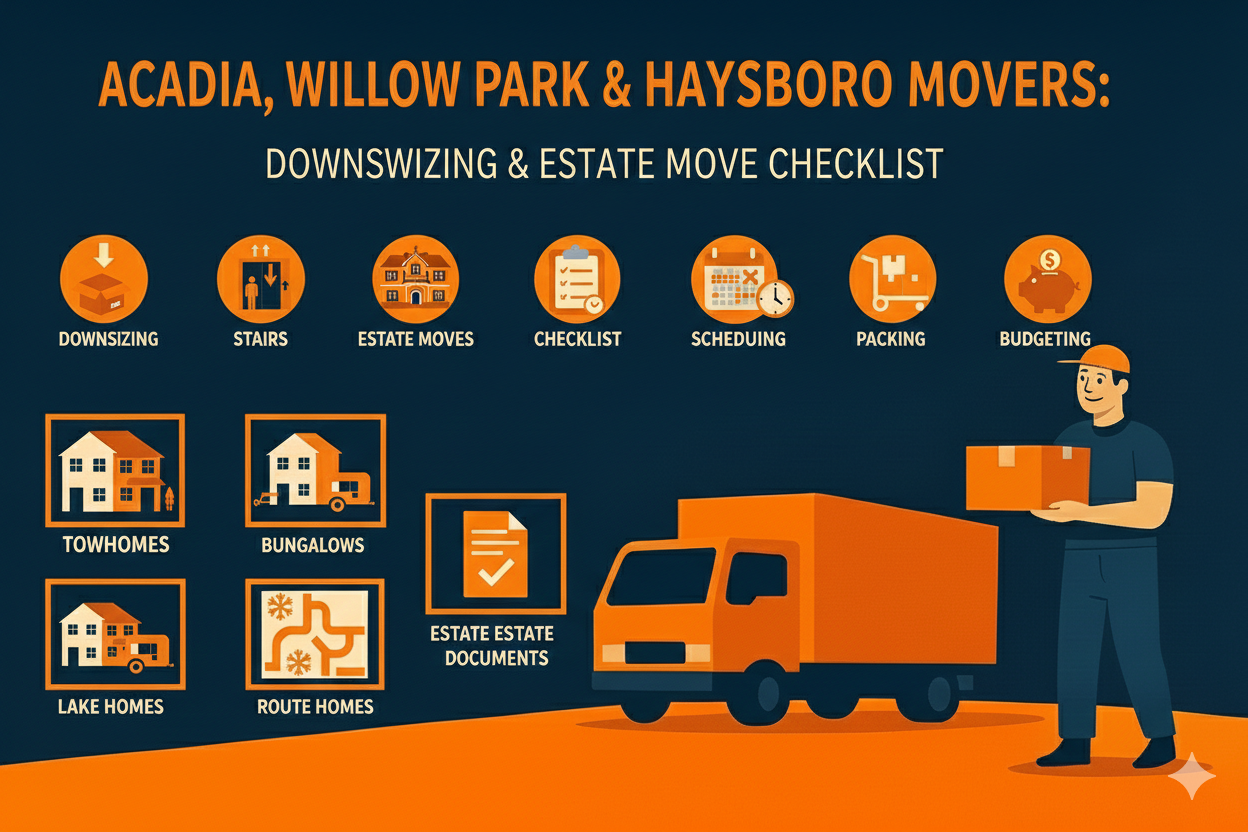
Downsizing and estate moves are not “regular moves.” They’re high-stakes transitions where every decision—what stays, what goes, what must be documented, what needs special handling—directly affects cost, timing, and peace of mind. In established communities like Acadia, Willow Park, and Haysboro, moves often involve decades of accumulated belongings, tight access points, fragile heirlooms, and time-sensitive coordination with family, realtors, condo boards, or estate timelines.
This guide is built to function like a working document: a practical, business-grade checklist that keeps the project controlled from planning to move day, and then through the first week after delivery.
Who This Checklist Is Built For
Downsizing Moves
A downsizing move typically includes:
- Reducing a household by 30%–70% (sometimes more)
- Prioritizing essential items for a smaller home, condo, or retirement community
- Coordinating donations, disposal, and sometimes storage
If you’re comparing service levels, pricing formats, and what actually affects cost, review moving pricing and packages early so decisions align with budget and scope.
Estate Moves
An estate move often includes:
- Sorting and distributing items among family members
- Keeping records for the executor
- Managing valuables, antiques, sensitive paperwork, and scheduled pickups
- Preparing a property for sale or handover
When the move involves aging parents or mobility constraints, specialized support matters. Use senior moving services as the benchmark for the level of care, pacing, and coordination your move should include.
Why Moves in Acadia, Willow Park & Haysboro Need a Smarter Plan
These neighborhoods often include:
- Mature homes with basements, tight stairwells, and older door frames
- Well-established streets where truck positioning and driveway access can make or break timing
- Higher likelihood of legacy furniture, antiques, and specialty items (pianos, art, china cabinets)
The difference between a smooth move and a frustrating one is usually not effort—it’s sequence. The order of operations below reduces rework, prevents packing mistakes, and protects valuables.
The 8-Week Downsizing & Estate Move Timeline
8 Weeks Out: Lock the Plan (Before You Touch a Box)
Checklist
- Confirm move date window (primary date + backup date)
- Decide destination requirements: elevator bookings, parking rules, key pickup schedule
- Identify decision-makers: who approves keep/donate/sell, and who signs off on costs
- Create a “Do Not Pack” zone: daily medications, ID, essential documents, chargers, basic kitchen items
- Start a master inventory sheet with these columns: Item / Room / Keep / Donate / Sell / Family / Dispose / Notes
Business rule: No packing begins until you define what you are packing and where it’s going. That single rule prevents wasted boxes and duplicate handling.
6 Weeks Out: Inventory + Value Protection (Estate-Smart Sorting)
This is where most estate moves go wrong: items move before value, ownership, or documentation is clear.
Checklist
- Photograph high-value items (front/back, serial numbers where available)
- Mark fragile and high-risk valuables: art, crystal, antiques, instruments
- Identify legal and sensitive documents: wills, deeds, insurance, banking, tax records
- Create a “Family Distribution” list (who gets what, and where it will go)
If antiques or heirloom furniture are involved, treat them as specialty freight—not “just furniture.” Use a professional benchmark for handling and protection like antique furniture moving services to guide expectations around wrapping, padding, and loading methods.
5 Weeks Out: Decide What Leaves the Home (Donation, Sale, Disposal)
A downsizing move is a volume-management project. The earlier you remove non-essentials, the cheaper and faster the move becomes.
Checklist
- Choose donation channels and schedule pickup/drop-off days
- Separate “sell” items and set a pricing deadline (anything unsold by X date becomes donation)
- Arrange junk removal or disposal runs
- Identify hazardous items movers won’t take (typical examples include certain chemicals, fuels, and flammables)
Tip for speed: Use three bins per room:
- Keep (moving)
- Leave (donate/sell/dispose)
- Unsure (revisit later—limit to one bin per room)
Room-by-Room Downsizing Checklist (Built for Real Homes)
Kitchen
The kitchen is where time disappears. It has high volume, fragile items, and “maybe we’ll use this” duplicates.
Checklist
- Keep only one primary set of cookware and dishes (or two, depending on household size)
- Discard expired pantry goods and open bottles you won’t finish before moving
- Pack fragile items by category: glassware, plates, serving pieces
- Label boxes with “KITCHEN – FRAGILE – OPEN FIRST”
Bedrooms and Closets
Closets lie. A closet that looks manageable often holds dozens of “small items” that balloon time.
Checklist
- Set a hard limit on clothing volume (e.g., X drawers + X feet of hanging space)
- Separate seasonal clothing for later packing
- Pack jewelry and small valuables into a personal carry kit, not the truck
Basement and Storage Areas
Basements are the final boss of downsizing.
Checklist
- Set a maximum number of “memory boxes”
- Decide what tools and hardware are realistically needed at the new place
- Sort holiday décor by keep vs. donate early—these boxes are time sinks
Specialty Items That Need Professional Handling
Some items should never be treated as standard household goods. If you have any of these, call them out early so the right materials and crew are assigned.
Pianos
Pianos require controlled movement, load management, and protection at every step. If a piano is part of the move, plan for it explicitly and follow specialty standards like piano moving services.
Checklist
- Confirm floor protection at pickup and drop-off
- Clear turns, hallways, and tight angles in advance
- Protect keys, pedals, and bench as separate components if required
Antiques, Art, and Heirlooms
Checklist
- Pre-measure doorways and stairwell turns
- Use layered protection: wrap + corner guards + padding
- Separate “display items” from “structural items” (frames, glass, pedestals)

Packing Standards That Prevent Damage and Delays
Labeling That Actually Works
Generic labels cause rework. Precise labels speed up unloading and reduce misplacement.
Use this format:
- Room + Destination + Priority
- Example: “PRIMARY BEDROOM – CLOSET – OPEN FIRST”
Box Weight Rules
- Keep boxes under a manageable lift weight
- Use small boxes for books, dense items, and fragile loads
- Use medium boxes for mixed household goods
- Keep heavy items low, light items above when packing
Building Access, Parking, and Move-Day Logistics
Whether you’re leaving a house or entering a condo, access planning saves hours.
Street and Truck Positioning
If you need formal approvals for street occupancy, loading zones, or temporary restrictions, consult municipal guidance through the City of Calgary and confirm local rules before move day.
Checklist
- Reserve driveway space and clear snow/ice if seasonal
- Confirm where the moving truck can legally stop
- Identify the shortest safe path from door to truck
- Protect floors and corners in high-traffic lanes
Elevator and Condo Rules
Checklist
- Book elevator times (if applicable)
- Confirm move-in/move-out windows
- Ask about protective pads, elevator keys, and security requirements
- Confirm damage deposits (if required)
Estate Move Governance: Keep the Paper Trail Clean
Estate moves benefit from structure because multiple stakeholders are involved.
Executor-Friendly Documentation Checklist
- Item inventory with photos
- Donation receipts (where available)
- Sale record list (what sold, where, and for how much)
- Distribution log (who received what and when)
- “Retained documents” list for storage and long-term keeping
For consumer rights and expectations when hiring service providers, reference official consumer guidance through the Government of Canada.
What a Professional Downsizing & Estate Move Should Include
When you engage a moving team for a downsizing or estate project, quality is measured by what they prevent: damage, delays, missed details, and miscommunication.
Service expectations to look for
- Clear scope definition (what’s included, what’s excluded)
- Confirmed schedule and staged approach
- Specialty handling options for antiques and instruments
- Accurate pricing and transparent constraints (stairs, long carries, specialty items)
If you want a high-level foundation on choosing movers and preventing common mistakes, keep this resource available: Movers in Ottawa: Your Ultimate Guide to Stress-Free Relocation in 2025.
Move Day: The Controlled Execution Checklist
Morning-Of Checklist
- Charge phones and keep chargers in your personal kit
- Confirm truck arrival window and crew contact
- Set aside personal carry items: IDs, medications, keys, documents
- Walk the home and identify “no-touch zones”
During Loading
- Keep one decision-maker available for real-time questions
- Confirm fragile items are loaded in protected positions
- Use a final walkthrough for each room after it’s cleared
At Delivery
- Place boxes by room first, not “wherever there’s space”
- Confirm high-value items are delivered and inspected early
- Identify what gets assembled immediately vs. later
First Week After the Move: Settle Fast Without Chaos
Most stress occurs after delivery when essentials are buried.
Checklist
- Open “priority boxes” first (kitchen basics, bedding, hygiene)
- Confirm any missing items while the inventory is fresh
- Break down boxes daily (do not let them pile up)
- Set up safe storage for documents and valuables
Common Downsizing Mistakes That Increase Cost
Packing Before Sorting
Every box you pack that later gets donated is double labor.
Keeping “Just in Case” Items Without a Space Plan
If the new home has no defined space for it, it becomes clutter immediately.
Ignoring Specialty Items Until the Last Week
This forces rushed handling and increases damage risk.
When to Use Storage During Downsizing
Storage is useful when:
- The destination isn’t ready
- Family distribution items need staging
- The home must be cleared quickly for listing or sale
But storage becomes expensive if it’s used as a substitute for sorting. Treat it as a short-term buffer, not a long-term decision delay.
Getting a Quote That Reflects Reality
Quotes are accurate when they reflect real conditions:
- stairs, elevators, long carries, specialty items
- packing requirements
- disposal/donation staging needs
Start with clear expectations using pricing details so the move scope matches the budget from day one.
Book the Move With a Clear Plan
Downsizing and estate moves succeed when planning is treated as part of the service—not an afterthought. If you’re coordinating timelines, specialty handling, or a family-driven distribution plan, get the conversation started early so the move is structured properly.
For scheduling, project scoping, and move coordination, use the direct intake channel here: Contact Prestige Moving.
FAQs
1) How far in advance should I plan a downsizing move in Acadia, Willow Park, or Haysboro?
Begin planning 6–8 weeks ahead to allow time for sorting, family distribution, donations, and specialty item preparation without rushed decisions.
2) What’s the fastest way to reduce volume before moving?
Use a strict room-by-room process with Keep / Leave / Unsure bins, schedule donation runs weekly, and set a firm deadline for selling items before they convert to donation.
3) How should antiques and heirlooms be packed for an estate move?
Use layered protection (wrap + corner protection + padding) and avoid mixing fragile heirlooms with general household goods. Specialty handling standards are strongly recommended.
4) Do I need movers who specialize in senior downsizing?
If the move involves mobility considerations, emotional stress, or complex coordination, a senior-focused approach improves pacing, safety, and decision support.
5) What should never go on the moving truck during an estate move?
Keep personal documents, IDs, medications, jewelry, and small valuables in a personal carry kit. Maintain a written list of what stays with you for accountability.